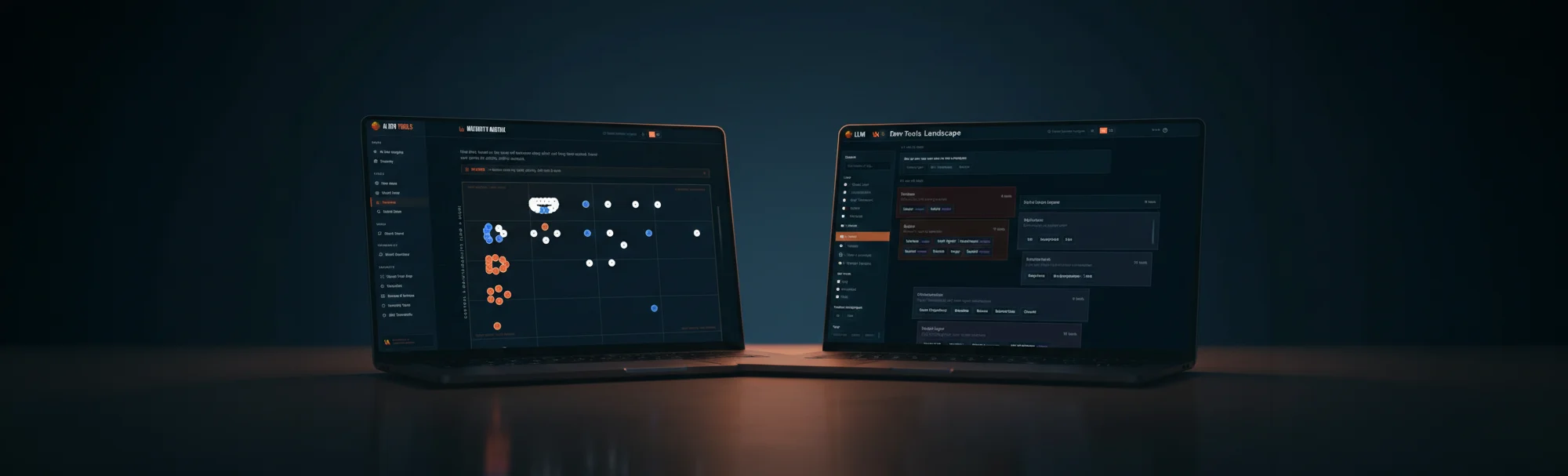
We've been building Stack Scout as a recommendation engine that helps developers pick the right tech stack. Describe what you want to build, get scored recommendations from 25 curated stacks, with trade-offs, risks, and a 48-hour implementation plan.
This week we shipped three big updates: MCP support, a ChatGPT App Store submission, and a dedicated Community section powered by Stack Overflow. Here's what changed, why we built it this way, and what it means for developers.
MCP: One Protocol, Two Transports
What is MCP?
Model Context Protocol (MCP) is a standard developed by Anthropic that lets AI assistants call external tools. Think of it as a universal plug for AI. Instead of building custom integrations for every AI assistant, you build one MCP server and any compatible client can use it.
Stack Scout now speaks MCP. That means ChatGPT, Claude Desktop, Cursor, VS Code, and any other MCP-compatible client can use our recommendation engine directly inside their interface.
How we built it
We implemented MCP in two transport modes, both sharing the same scoring engine under the hood:
A stateless Netlify Function at https://aidevtools.app/mcp that speaks JSON-RPC 2.0 over HTTP POST. This is what ChatGPT uses. No authentication required, no session state, no user data stored.
A Node.js process in mcp-server/index.ts for local tools like Claude Desktop, VS Code, and Cursor. Same tools, same scoring, different transport.
The three tools
Both transports expose exactly the same three tools:
| Tool | What it does |
|---|---|
| recommend_stack | Get top-3 stack recommendations based on your use case, team size, budget, timeline, and requirements |
| compare_stacks | Compare 2-4 specific stacks side by side with scoring breakdown |
| list_available_stacks | Browse all 25 curated stacks with metadata, components, and GDPR fit |
Every tool is read-only and idempotent. Same input, same output, every time.
The scoring engine
Under the hood, all recommendations run through a deterministic scoring engine that evaluates stacks on five axes: speed, cost, privacy, developer experience, and scalability. The engine applies weighted priorities based on your context and returns the best-fit options with transparent score breakdowns.
No LLM involved in the scoring itself. It's math, not magic. The stack database is a static JSON file with 25 curated stacks that we maintain manually.
Security posture
We mapped our implementation against OpenAI's MCP Risks and Safety guidelines:
- -No user data storage. Requests are processed in-memory and immediately discarded.
- -No write actions. All tools are read-only.
- -No external API calls from the MCP endpoint.
- -No payload logging. We don't log tool arguments or request bodies.
- -CORS locked to
https://chatgpt.com.
Built once, distributed three ways
When we built the MCP endpoint, we didn't build it for any single client. We built it as a general-purpose tool server. The same scoring engine now serves three channels:
Shared Scoring Engine + Stack Database
scoring.ts + stacks.json
Website
(React)
Stack Scout UI
REST API
(/v1/*)
Mobile apps, scripts
MCP
(/mcp)
ChatGPT, Claude, Cursor
Three channels. One truth. Zero sync issues.
ChatGPT Apps: Same Engine, New Audience
Stack Scout is now submitted to the ChatGPT App Store as a native MCP app. When approved, any ChatGPT user can ask questions like "What's the best stack for a SaaS invoice app?" and get our recommendations directly inside ChatGPT, with scoring, trade-offs, and a concrete implementation plan.
What it is not
Stack Scout is not a chatbot. It's not a wrapper around GPT. The scoring is fully deterministic and runs server-side without any LLM calls. ChatGPT acts as the natural language interface that translates your question into structured parameters, calls our tools, and formats the response. The intelligence sits on ChatGPT's side. The accuracy and consistency sit on ours.
Advantages
Reach.
ChatGPT has hundreds of millions of users. We have a niche developer tool. The App Store puts Stack Scout in front of an audience we could never reach through SEO alone.
Zero friction.
Users don't need to visit our website, learn the interface, or understand how the recommendation engine works. They just ask a question in ChatGPT and get an answer.
Automatic context.
ChatGPT is great at extracting structured data from natural language. Users can describe their project in their own words and ChatGPT translates that into the right parameters.
Disadvantages
No control over the experience.
ChatGPT might summarize, reformat, or add its own commentary. The data is accurate, but the framing is ChatGPT's.
Attribution.
Users might not even know they're using Stack Scout. Great for user experience, not great for brand awareness.
Dependency.
If OpenAI changes their MCP implementation, deprecates the App Store, or adjusts their policies, we're at their mercy.
Community: Stack Overflow in Your Workflow
Every developer reaches a point where documentation isn't enough. You need to see how someone else solved the same problem. We added a dedicated Community section to AI Dev Tools that gives you three things:
Search Stack Overflow directly from within AI Dev Tools. Quick search tags for common queries like "Supabase RLS" or "Next.js auth best practices".
Stack Overflow's AI-powered answers backed by community-verified knowledge. Direct link from the Community section.
Stack Overflow offers an MCP Server that connects directly to Cursor, Claude Code, or Copilot. Query Stack Overflow from inside your IDE.
Community is now a full section in the navigation. We believe that developer decisions should be informed by both curated recommendations (what Stack Scout does) and community experience (what Stack Overflow provides). The two complement each other.
What's Next
These three updates share a common thread: making Stack Scout available where developers already are. On our website, inside ChatGPT, inside your IDE, and connected to the community you already rely on.
The stack database now contains 25 curated stacks covering everything from rapid MVP setups (Next.js + Supabase + Vercel) to enterprise-grade configurations (Azure + .NET + OpenAI) and privacy-first options (self-hosted Docker + Ollama).
Feedback or suggestions?
Have ideas about Stack Scout, the MCP integration, or the Community section? Let us know.